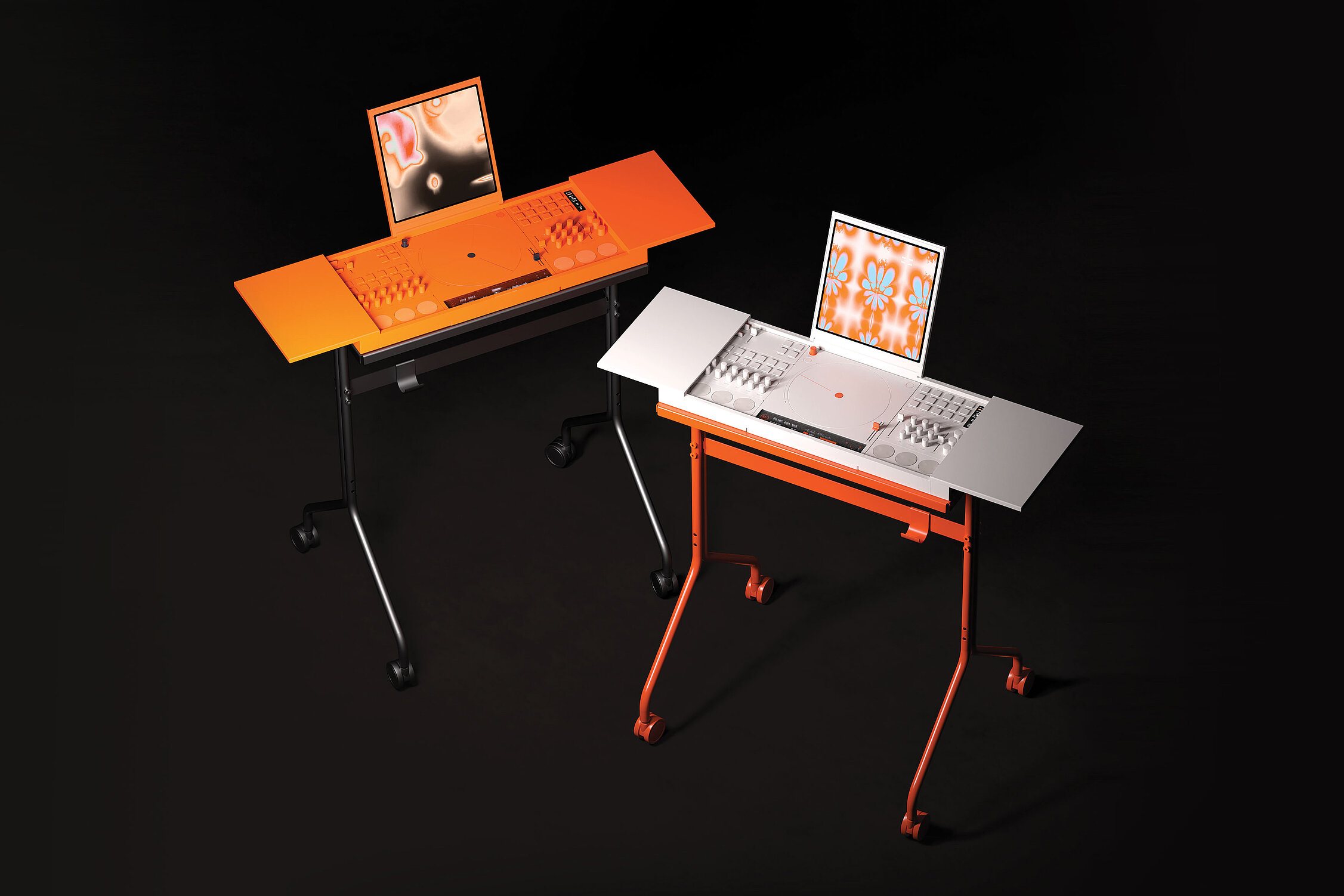
The music hardware market has spent years chasing two divergent audiences: professionals who want granular control and casual listeners who want simplicity. Daize, the Red Dot Award-winning concept from South Korean designer Hong Jeongyeon, suggests these groups might want the same thing after all.
The device looks like something you'd find in a design museum gift shop. A foldable body finished in bold two-tone colors. A square screen that deliberately echoes vinyl cover dimensions. And at its center, a rotary controller lifted straight from turntable culture. The aesthetic choices are calculated, drawing on decades of tactile music interaction that streaming services have systematically erased.
Generative AI With a Physical Interface
What distinguishes Daize from the flood of AI music tools is its insistence on physicality. The core feature, called AI Gen Node, lets users blend original recordings with AI-generated elements through actual knobs and sliders. Turn a dial to introduce algorithmic variations. Push a fader to pull the track back toward its source material. The interface treats generative AI as an instrument rather than a black box.
This approach addresses a persistent problem with AI creative tools. Most of them operate through menus and text prompts, which creates distance between intention and output. Recent advances in AI creative software have democratized capabilities, but they've also introduced friction. Daize bets that muscle memory still matters.
The Modular Problem
The device's panel system can be reconfigured for different use cases. Sound mixing in one arrangement, environmental effects in another, live performance controls in a third. This modularity echoes the eurorack synthesizer philosophy that has sustained hardware audio culture for decades.
Whether Daize can actually deliver on this flexibility remains to be seen. Modular systems tend to work beautifully in concept videos and struggle with real-world workflow integration. The design renders show clean, intuitive layouts. Actual music production is messier.
Still, the visual feedback loop is clever. Dynamic graphics synchronize with audio output, creating what Hong describes as multi-sensory immersion. The approach recalls visualizers from the peak analog era, updated for an audience raised on music videos and social media clips.
Who Actually Wants This
The pitch positions Daize somewhere between a high-end speaker and a production workstation. Relaxation, live performance, professional soundscaping. That breadth might be a weakness. Products that try to serve everyone often serve no one particularly well.
But there's a market for devices that treat music engagement as an activity rather than background noise. Teenage Engineering built a business on this premise. So did the resurgent vinyl industry.
Daize is still a concept, awarded for design excellence rather than commercial viability. Whether it reaches production depends on finding manufacturing partners willing to bet on tactile AI interfaces. The appetite for physical interaction with digital tools is real. The question is whether it extends beyond enthusiast niches.