Most of the planet's surface is ocean, and almost none of it is used for anything. No infrastructure, no people, no energy generation. Just water moving endlessly under its own physics. Panthalassa thinks that unused vastness is exactly where the next generation of power and compute infrastructure belongs.
The company has developed a system for harvesting energy from open ocean dynamics and, crucially, pairing it with compute hardware directly on the water. Waves, currents, and the constant kinetic churn of deep water all contain enormous untapped energy. Panthalassa's approach involves deploying what it calls Nodes into these environments, converting that motion into electricity, and in many cases using that electricity on board to run AI workloads rather than transmitting the power back to shore.
The Node System
Each Node is roughly 66 feet wide and 260 feet tall, a structure the company has likened to a giant lollipop floating in deep water. Water is funneled through internal channels to create a pressurized system that spins turbines and produces electricity. The Nodes are designed to survive the harsh conditions of open ocean deployment, operating autonomously for extended periods while withstanding salt corrosion, storms, and the general hostility of marine environments.
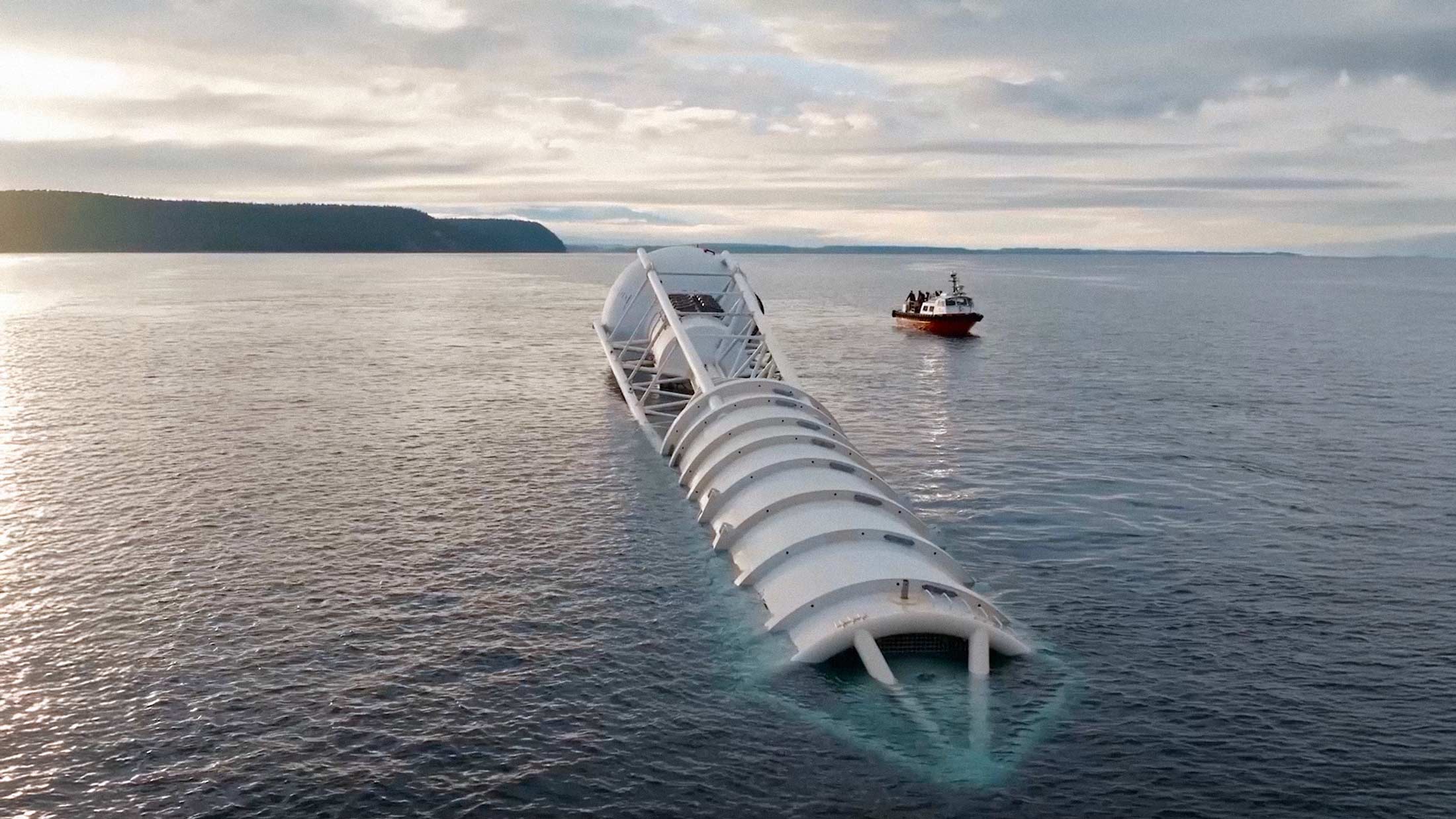
The more interesting part of the design is what happens to the electricity. Panthalassa's pitch goes beyond generating clean power; it proposes putting GPU and TPU servers directly on the Nodes, cooled by ambient seawater, and beaming the AI compute output to shore via Starlink. That removes the hardest problem in offshore energy—getting electrons back to land—and replaces it with something much easier: moving data. The ocean becomes both the power source and the datacenter.
Why Now
The timing here matters. Global electricity demand is accelerating faster than most projections anticipated, driven largely by the computational requirements of artificial intelligence. Training and running large language models, powering data centers, and building out the inference infrastructure for AI applications all require staggering amounts of power. Major technology companies are signing deals for nuclear capacity that would have seemed implausible five years ago.
This energy crunch has forced a broader rethinking of what power sources are viable. Solar and wind have scaled impressively, but they're constrained by land availability and intermittency. Nuclear is experiencing a renaissance in perception, with both traditional plants and small modular reactors attracting serious investment. Even space-based nuclear installations are now on federal roadmaps.
Ocean energy has historically been a footnote in these discussions. Previous attempts at wave power have been small-scale demonstrations, often dependent on coastal installations where wave patterns are less consistent. Panthalassa's bet is that going further out, into the open ocean where energy density is higher and more predictable, changes the economics entirely.
The Scale of the Resource
The numbers suggest they might be right. The International Energy Agency estimates that ocean energy, including waves, tides, and thermal gradients, could theoretically provide multiple times current global electricity consumption. The practical fraction of that is smaller, but even a modest slice of ocean kinetic energy would represent a significant new power source.
Founder Garth Sheldon-Coulson has spoken about the ocean as the last major untapped energy frontier. The logic is straightforward: oceans cover 70 percent of Earth's surface and are in constant motion. That motion is driven by solar heating, lunar gravity, and planetary rotation. It never stops.
What Comes Next
Panthalassa has raised over $78 million to date, backed by investors including Space Capital and others betting on energy-compute convergence. The company completed full-scale prototype testing off the coast of Washington state last summer and is currently building a pilot manufacturing facility near its headquarters in Portland, Oregon. Commercial deployment has not yet begun. Customer preorders are not open.
Founder Garth Sheldon-Coulson has publicly discussed the economics: roughly a billion dollars, he's said, would fund a factory capable of producing a gigawatt of Node capacity per year. That's an ambitious claim from a company that has yet to ship a commercial unit, but it outlines the scale of what Panthalassa is actually trying to build.
The hurdles are significant. Reliability at sea is brutal in ways that land-based infrastructure never contends with. Maintenance costs for far-offshore hardware can eat margins quickly. Pairing compute hardware with unstable energy output is a real engineering challenge, even with battery buffering. And as with any offshore energy project, regulatory frameworks around ocean deployment remain ambiguous in most jurisdictions.
If Panthalassa succeeds, it opens a strange new geography of infrastructure. Power plants and datacenters sitting hundreds of miles from any coast, harvesting energy from water that has been moving since long before humans existed, processing AI workloads, and sending the results up through space. It's an odd image. Given the trajectory of AI power demand, it might also be one of the more rational responses.